
Controlling residual stress in laser 3D printing of nickel-titanium alloys
2025-12-06
Nickel-titanium (NiTi) alloys are widely used in vascular stents and orthopedic implants due to their unique superelasticity (the ability to recover large deformations after unloading). This property stems from the reversible martensitic phase transformation between the B2 austenite and B19′ martensite phases. However, NiTi has poor thermal conductivity and high hardness, making it difficult to manufacture complex geometric parts using traditional methods. Laser powder bed melting (LPBF) technology can achieve rapid forming of complex NiTi structures, but the high cooling rate (10³–10⁶ K/s) introduces significant residual stress.
Negative effects of residual stress: reduced formability, induction of cracks, increased dislocation density (~10¹⁴ m⁻²), and hindering the reverse phase transformation of martensite through local stress fields, accumulating unrecoverable strain, and impairing hyperelasticity.
Limitations of existing control methods: Although process parameter optimization (laser power, scanning speed, etc.) can partially reduce residual stress, it is difficult to achieve stable hyperelasticity under large deformation; heat treatment is a direct control method, but the mechanism by which residual stress distribution and intensity affect hyperelasticity is still unclear.

This study significantly improves the hyperelastic reliability of LPBF-NiTi by optimizing residual stress through heat treatment processes, which has important engineering significance for customized vascular stents and orthopedic devices. Future research could combine multi-scale simulations to predict residual stress evolution and explore the regionalized regulation of stress and function through gradient heat treatment.
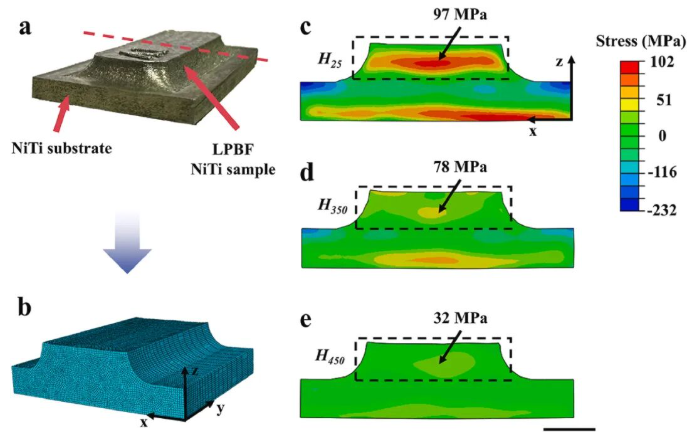
The 723 K/4 h heat treatment reduced the peak residual stress of LPBF-NiTi from 97 MPa to 32 MPa, and the distribution changed from annular to uniform.

The reduction in residual stress decreased the ε_ir from 7.24% to 1.35% in the first cycle, while the recoverable strain increased from 2.70% to 5.68% in the 20th cycle.
The release of residual stress reduced dislocation density, and the morphology changed from tangled dislocations to movable dislocation lines; the formation of dislocation loops during the cycle further enhanced the hyperelastic stability.