
Simulation of Curing Deformation and Residual Stress of Composite Materials Based on Abaqus
2025-11-13
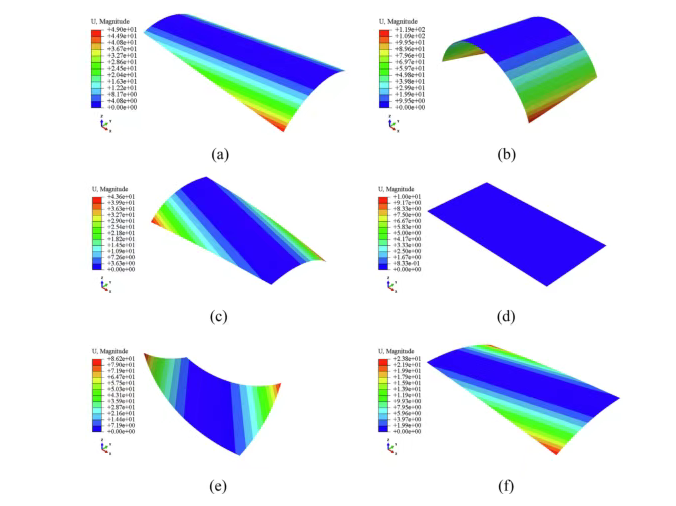
Abaqus was used to predict deformation and residual stress during the curing process of composite materials. The curing behavior of composite materials can be decomposed into four important stages: heat conduction, curing crosslinking reaction, resin flow-compaction, and curing deformation, involving subroutines such as Hetval, Uexpan, and Umat.
Temperature field research has always been a major research hotspot in the manufacture of composite material components. The temperature field affects the thermophysical properties, chemical shrinkage, and residual stress of materials by influencing the degree of curing and curing rate of the resin. Therefore, there are many simulation studies focusing on thermo-chemical coupling.

The manufacturing process of a product generates residual stress, which mainly includes the following processes: hot working (casting, forging, welding), heat treatment and cold working (forming, machining, grinding), electroplating and hot-dip galvanizing, surface chemical heat treatment (carburizing, nitriding, etc.) and assembly.
Generally, the fatigue strength of a component subjected to alternating stress increases when residual compressive stress is present, while the fatigue strength decreases when residual tensile stress is present. Appropriate and well-distributed residual compressive stress can be a crucial factor in improving fatigue strength, enhancing resistance to stress corrosion, and thus extending the service life of parts and components.

In composite material curing simulations, the subroutine USDFLD is typically used to characterize the degree of curing during the curing process. The variable FIELD is defined to represent the degree of curing at each integration point in each incremental step; the variable STATEV is defined to pass data to other subroutines such as Hetval. In the initial load step, the degree of curing cannot be defined as 0; typically, STATEV(1) is set to a very small value.
The fiber volume fraction has a certain impact on resin exothermic response, curing shrinkage, and residual stress. Changes in fiber volume fraction mainly occur during the resin flow-compaction process. However, many simulation models neglect the resin flow-compaction behavior, treating the fiber volume fraction as a constant. The resin flow-compaction behavior can be viewed as a saturated flow problem in porous media, and its governing equations can be derived based on Darcy’s law and the effective stress principle.

Umat is primarily used to define the stress and material Jacobian matrix of nodes in the current increment step. During the curing process, the engineering elastic constants of the composite material are related to multiple state variables such as temperature and degree of cure. Therefore, Umat needs to be written based on different mechanical constitutive models to update these relevant state variables. This part involves the coupling of Umat with other subroutines, which is quite complex.
Taking the coupling of Umat and Uexpan as an example, in stress-displacement analysis, Uexpan recalculates the degree of cure of the composite material using the transmitted temperature field, and then transmits variables such as the material integration point temperature field variable, degree of cure field variable, and non-mechanical strain field variable to Umat.